
What Is Keyword Mapping in SEO?
Keyword mapping is one of the most important parts of modern SEO. Yet many websites still ignore it.
People often publish random blog posts without a clear structure. As a result, their pages compete against each other. Search engines get confused. Rankings drop. Traffic becomes unstable.
Keyword mapping solves this problem.
It helps you assign the right keywords to the right pages. It also helps search engines understand your website structure better.
Today, keyword mapping is not only important for traditional SEO. It also matters for AEO (Answer Engine Optimization) and GEO (Generative Engine Optimization).
AI systems now look for semantic relationships, entities, topical depth, and structured information. A strong keyword map helps with all of these things.
What Is Keyword Mapping?
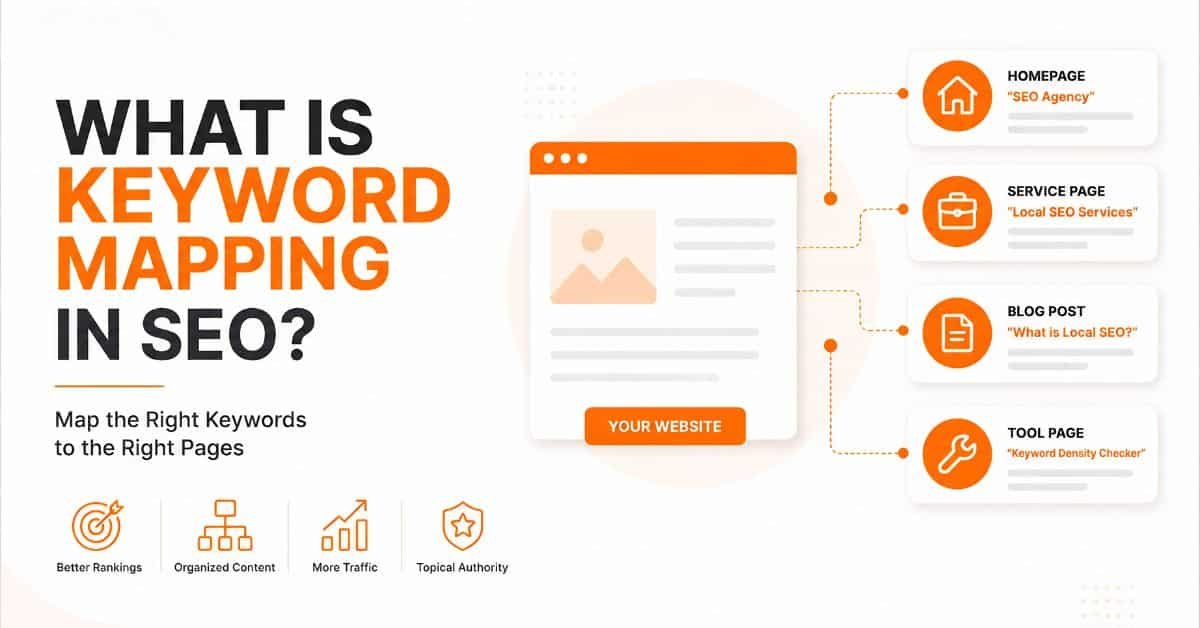
Keyword mapping is the process of assigning target keywords to specific pages on a website. Each page gets primary and secondary keywords. It also includes the use of related semantic terms and, most importantly, matching search intent.
This process helps search engines understand:
- What is each page about?
- Which page should rank for which query?
- How do different pages connect together?
For example:
- Homepage targets a broad business keyword
- Service page targets a commercial keyword
- Blog post targets informational keywords
- Product page targets transactional keywords
Instead of creating confusion, keyword mapping creates structure.
Example of Keyword Mapping in SEO
| Page | Primary Keyword | Search Intent |
|---|---|---|
| Homepage | SEO agency | Commercial |
| Service Page | local SEO services | Transactional |
| Blog Post | what is local SEO | Informational |
| Tool Page | keyword density checker | Utility |
Each page targets a different intent and topic. This helps search engines rank the correct page for the correct query.
Keyword Mapping vs Keyword Research
Many people confuse keyword mapping with keyword research. However, both are different.
Keyword research helps you find the right keywords and discover search terms people use online.
Keyword mapping helps you assign those keywords to the right pages.
Think of it like this:
- Keyword research finds opportunities
- Keyword mapping organizes those opportunities
You need both for successful SEO.
Why Keyword Mapping Is Important in SEO?
Keyword mapping improves almost every part of SEO.
Without keyword mapping:
- Pages overlap
- Search engines get confused
- Rankings become unstable
- Internal linking stays weak
With keyword mapping:
- Content becomes organized
- Rankings improve
- Authority grows faster
Here are the biggest benefits.
Helps Prevent Keyword Cannibalization
Keyword cannibalization happens when multiple pages target the same keyword.
For example:
- Two blog posts target “best SEO tools”
- Google cannot decide which page should rank
- Both pages perform poorly
Keyword mapping prevents this issue.
You clearly define:
- Which page owns which keyword
- Which page supports another topic
This improves ranking stability.
Improves Topical Authority
Modern SEO focuses heavily on topical authority. Search engines want websites that cover topics deeply.
Keyword mapping helps you build:
- Topic clusters
- Semantic relationships
- Content ecosystems
As a result, your website looks more authoritative.
Improves Website Structure
Keyword mapping creates a cleaner on-page SEO architecture.
It helps you organize:
- Categories
- Service pages
- Blog content
- Supporting articles
This makes crawling and indexing easier.
Helps AI Search Engines Understand Content
AI search systems like:
- ChatGPT
- Google AI Overviews
- Gemini
- Perplexity
- Copilot
do not only look at keywords.
They also analyze:
- Entities
- Semantic meaning
- Context
- Relationships between topics
Keyword mapping helps create these relationships naturally.
That improves your chances of getting cited inside AI-generated answers.
Core Elements of Keyword Mapping
A strong keyword map includes several important elements.
Primary and Secondary Keywords
A primary keyword is the main keyword a page targets.
Example:
- “keyword mapping in SEO”
Every page should usually have one main primary keyword.
Secondary keywords support the main keyword.
Example:
- SEO keyword mapping
- keyword mapping strategy
- keyword mapping process
These variations help search engines understand the topic more deeply.
Search Intent
Search intent is extremely important. There are four main types:
- Informational
- Navigational
- Commercial
- Transactional
Your content must match intent correctly.
For example:
- “What is keyword mapping” needs educational content
- “Best keyword mapping tool” needs comparison content
URL Structure
URLs should stay:
- Clean
- Short
- Descriptive
Example:
- /keyword-mapping-seo/
Avoid messy URLs with random numbers or symbols.
Content Type
Different keywords require different content formats.
Examples include:
- Blog posts
- Landing pages
- Product pages
- Tool pages
- Comparison pages
Choose the correct format for the keyword intent.
Search Funnel Stage
Some keywords target early-stage users. Others target buyers.
Your keyword map should cover:
- Awareness stage
- Consideration stage
- Decision stage
This creates a full-funnel SEO strategy.
How to Create a Keyword Map for SEO?
Want to create a keyword map for better SEO? Follow these steps to map keywords for your websites the right way.
Step 1: Perform Keyword Research
Start with keyword research.
Use tools like:
Focus on:
- Search intent
- Keyword difficulty
- Search volume
- Business relevance
Do not chase only high-volume keywords. Instead, focus on topical relevance.
Step 2: Group Related Keywords
Next, group keywords into clusters.
For example:
Main topic:
- Keyword mapping
Related terms:
- SEO keyword mapping
- keyword mapping strategy
- keyword mapping examples
- keyword mapping template
This creates semantic relationships.
Step 3: Analyze Existing Pages
Review your current website.
Look for:
- Duplicate keyword targeting
- Thin pages
- Missing topics
- Weak-performing pages
A content audit helps identify gaps.
Step 4: Assign Keywords to Relevant Pages
Now assign keywords carefully.
Best practice:
- One page = one primary keyword
However, a page can still rank for many related keywords naturally.
Step 5: Identify Content Gaps
Look for missing opportunities.
Examples:
- Missing beginner guides
- Missing comparison content
- Missing FAQs
- Missing transactional pages
Fill these gaps strategically.
Step 6: Build Internal Links
Internal linking is a major part of keyword mapping.
Create:
- Topic clusters
- Hub-and-spoke structures
- Contextual links
This strengthens semantic relationships.
Step 7: Optimize for AEO and GEO
Modern SEO now goes beyond Google rankings.
You should also optimize for:
- AI search engines
- Voice search
- AI-generated summaries
Here are some important strategies:
- Use clear headings
- Add concise answers
- Include FAQs
- Use schema markup
- Cover entities naturally
- Write conversational content
These improvements help AI systems understand your content better.
Step 8: Track and Update Regularly
SEO changes constantly.
Monitor:
- Rankings
- Traffic
- Click-through rates
- Search intent shifts
Update your keyword map regularly.
Keyword Mapping for Modern SEO
Keyword Mapping for Semantic SEO
Semantic SEO focuses on meaning rather than exact phrases. Keyword mapping supports semantic SEO by helping you:
- Build topic clusters
- Cover related concepts
- Connect entities
- Create contextual relationships
This improves topical authority significantly.
Keyword Mapping for AEO
AEO stands for Answer Engine Optimization. It focuses on helping search engines provide direct answers.
To optimize for AEO:
- Use question headings
- Add concise definitions
- Write simple explanations
- Add FAQ sections
- Use structured formatting
This improves visibility in:
- Featured snippets
- AI Overviews
- Voice search results
Keyword Mapping for GEO
GEO stands for Generative Engine Optimization. It focuses on AI-driven search systems.
AI systems prefer content that:
- Covers topics deeply
- Uses semantic relationships
- Includes trusted entities
- Answers questions clearly
- Builds contextual understanding
Keyword mapping helps create this structure naturally.
How Often Should You Update Keyword Mapping?
Update keyword maps regularly.
Good times include:
- Quarterly SEO reviews
- Major algorithm updates
- Content audits
- New product launches
- Ranking drops
SEO is not static.
Your keyword strategy should evolve continuously.
Signs Your Website Needs Better Keyword Mapping
You may need better keyword mapping if:
- Multiple pages rank for the same keyword
- Rankings fluctuate heavily
- Organic traffic stays low
- Internal linking feels random
- Topical authority remains weak
- Important pages do not rank
These are common signs of structural SEO problems.
Final Thoughts
Keyword mapping is the foundation of modern SEO. It helps search engines understand your website pages, structure, authority, and expertise. Instead of publishing random content, build connected topic clusters with clear keyword targeting.
That approach works much better today. And it will likely matter even more in the future.
Frequently Asked Questions
What is keyword mapping in SEO?
Keyword mapping is the process of assigning target keywords to specific pages on a website to improve rankings and organization.
Why is keyword mapping important?
It helps prevent keyword cannibalization, improves topical authority, strengthens internal linking, and improves search visibility.
What is the difference between keyword research and keyword mapping?
Keyword research finds keywords. Keyword mapping assigns those keywords to the correct pages.
How do you create a keyword map?
You perform keyword research, group related terms, assign keywords to pages, build internal links, and track performance regularly.
Does keyword mapping help AI search engines?
Yes. It improves semantic structure, contextual relevance, and entity relationships, which helps AI systems understand content better.
How often should keyword mapping be updated?
Most websites should review keyword maps every few months or after major SEO changes.
What is keyword cannibalization?
Keyword cannibalization happens when multiple pages compete for the same keyword, which can hurt rankings.
