
What Is Keyword Difficulty and How Is It Measured?
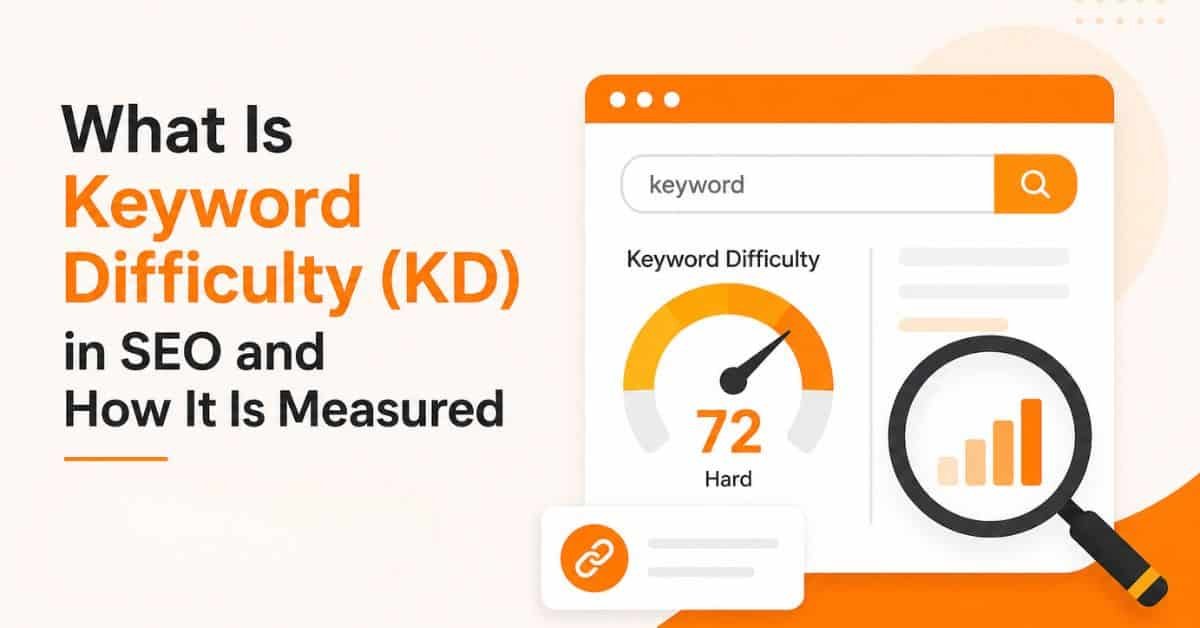
Keyword difficulty, or KD, shows how hard it is to rank on Google for a keyword. In simple words, it tells you how tough the competition is. The higher the score, the harder it is to get to page one.
If you choose the wrong keywords, you may work hard but still not rank. That is why KD plays a big role in SEO.
What Is Keyword Difficulty in SEO?
Keyword difficulty is a score, usually from 0 to 100. It tells you how strong your competition is.
Keyword difficulty shows how hard it is to rank for a keyword based on competition, backlinks, and content quality.
- Low KD = easy to rank
- High KD = hard to rank
Think of it like a race.
If you run against beginners, you can win easily. But if you run against trained athletes, it gets tough. Keywords work the same way.
Among long tail and short tail keywords, long ones usually have low difficulty.
Why Keyword Difficulty Matters in SEO Strategy?
KD helps you make smart choices.
- Saves your time. You avoid keywords that are too hard.
- Helps you find quick wins. You can target right keywords for SEO and get traffic faster.
- Helps you plan your content. You can start small and grow step by step.
However, do not rely only on KD. You also need to check intent and content quality.
New vs Old Websites
- New websites should target low KD keywords
- Strong websites can target medium or high KD keywords
If you ignore this, you may not rank at all.
How Keyword Difficulty Is Measured?
Tools use different methods, but most follow similar signals. Let’s break them down.
1. Backlinks of Top Ranking Pages
This is the most important factor. Tools look at the top 10 results on Google. Then they check how many websites link to them.
- More backlinks = stronger pages = higher difficulty
If top pages have hundreds of links, it will be hard to beat them.
2. Domain Strength (Website Authority)
Big websites rank easier. For example, large brands already have trust and authority. So they dominate many keywords. If you compete with strong domains, your job becomes harder.
3. Page-Level Authority
Sometimes a strong website ranks with a weak page. In that case, you can still beat it with better SEO content. So always check the page, not just the website.
4. Content Quality and Depth
Google wants the best answer. If top pages have deep, helpful content, the keyword becomes harder.
If their content is weak or outdated, you have a chance. So KD is not only about links. Content matters a lot.
5. Search Intent Match
Search intent means what the user wants.
For example:
- “how to tie shoes” → informational
- “buy running shoes” → transactional
If your content does not match intent, you will not rank.
Even a low KD keyword can be hard if you miss intent.
6. SERP Features and Competition Type
Search results are not just blue links anymore.
You may see:
- Featured snippets
- Ads
- AI answers
These take up space on the page. So even if you rank, you may get fewer clicks. That makes the keyword harder in real life.
7. Search Volume (Indirect Factor)
Search volume is not always part of KD, but it still matters. High volume or primary keywords attract more competition. So they often become harder over time.
Keyword Difficulty Score Scale
| KD Score | Difficulty | Meaning |
|---|---|---|
| 0–20 | Easy | Low competition |
| 21–40 | Medium | Can rank with effort |
| 41–60 | Hard | Needs strong SEO |
| 61–100 | Very Hard | Very competitive |
Keyword Difficulty vs Keyword Competition
Many people get confused here. Keyword difficulty is about SEO (organic results). Keyword competition is about ads (Google Ads).
So both are different.
You can have:
- High KD + low ad competition
- Low KD + high ad competition
How to Check Keyword Difficulty?
You can check KD using keyword research tools like:
- Ahrefs
- Semrush
- Ubersuggest
Steps to measure KD:
- Open any of the keyword research tools
- Enter your keyword
- Check the KD score
- Look at the top results
However, do not stop there. Always go deeper.
How to Analyze Keyword Difficulty Manually (Pro Method)
This is where smart SEO wins. Do not trust the KD number blindly. Instead, check the search results yourself.
Look for these signs:
- Weak or thin content
- Low backlinks
- Forums or discussion pages ranking
If you see these, you have a chance. Find content gaps. Ask yourself:
- Can I write better content?
- Can I explain it more clearly?
- Can I add more value?
If yes, go for that keyword.
What Is a Good Keyword Difficulty Score?
There is no single answer. It depends on your site.
- New website → KD 0–30
- Growing website → KD 20–50
- Strong website → KD 40+
Start small. Then move up as your site grows.
Common Mistakes When Using Keyword Difficulty
Many people use KD the wrong way. Here are common mistakes:
- Trusting KD blindly
- Ignoring search intent
- Choosing very hard keywords too early
- Not checking search results manually
- Ignoring keyword density
- Focusing only on numbers, not content
Always check keyword density of your content, as optimizing it is crucial.
Keyword Difficulty in the Age of AI
Search is changing fast. Google now shows AI answers. These answers reduce clicks. So ranking alone is not enough anymore.
What you need now:
- Clear and simple content
- Full topic coverage
- Strong authority
Also, structure your content well. Use headings and direct answers. KD still matters. But it is only one part of the game now.
Final Thoughts
Keyword difficulty is a helpful guide. It shows you where to focus. However, it is not the only factor.
You should combine KD with:
- Search intent
- Content quality
- Manual analysis
Start with easy keywords. Then grow step by step. If you follow this approach, you will see real results in SEO.
