
Long Tail vs Short Tail Keywords – What’s Better?
Keywords help people find your content on search engines. When someone types a query on Google, they use keywords. That is why for good SEO it is crucial to find right keywords.
There are two main types of keywords. These are long tail keywords and short tail keywords. Both play an important role in ranking and traffic.
Many beginners ask one simple question. Long Tail vs Short Tail Keywords – Which one is better?
The answer is not so simple. Each type works for a different goal. If you understand how they work, you can use them in the right way.
What Are Long Tail Keywords?
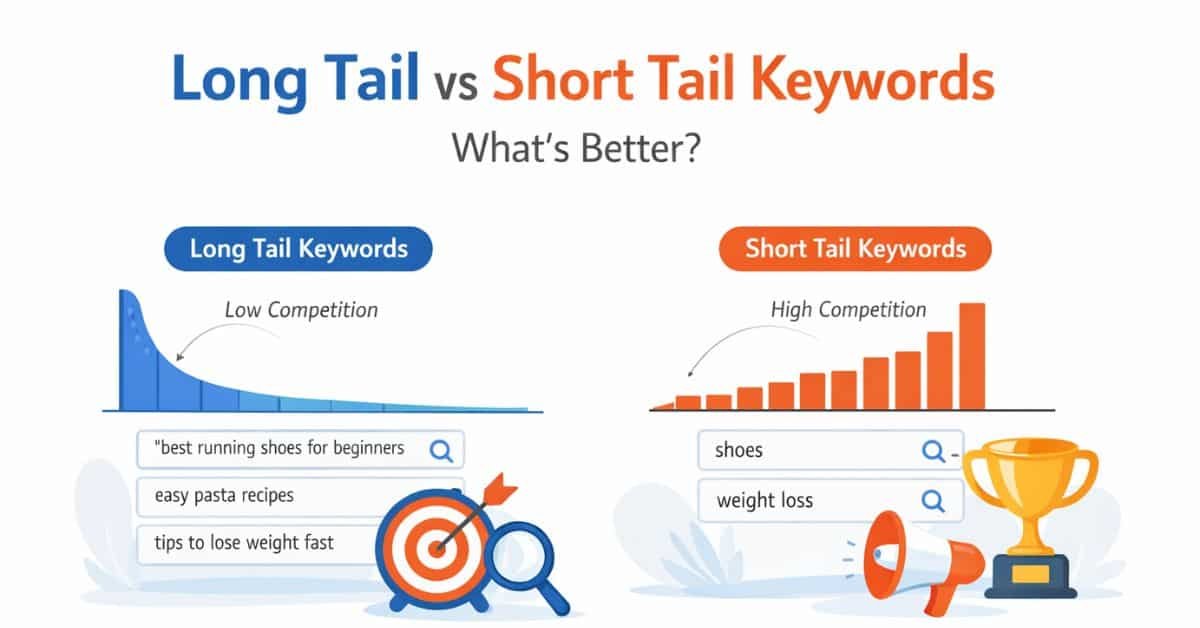
Long tail keywords are longer and more specific phrases. They usually contain three or more words.
For example:
- “best running shoes for beginners”
- “how to lose weight at home”
These keywords target a very specific search. Because of this, they bring people who know exactly what they want.
A 2024 study by Ahrefs found that over 94% of all keywords get fewer than 10 searches per month. This shows that most searches are actually long tail in nature.
This means one important thing. Even though each keyword has low volume, together they make a huge share of search traffic.
Also, long tail keywords often show clear intent. This helps you create content that matches what users want.
What Are Short Tail Keywords?
Short tail keywords are short and broad. They usually contain one or two words.
For example:
- “shoes”
- “weight loss”
These keywords cover a wide topic. Because of this, they get a lot of searches.
But they also come with a problem. They are very competitive. Many big websites target these keywords. That makes it hard for new websites to rank.
Also, short tail keywords do not show clear intent. For example, if someone searches “shoes,” you do not know what they want. They might want to buy, learn, or just browse.
A 2025 SEO report by Semrush shows that high-volume short keywords (usually over 100,000) often have keyword difficulty scores above 70%. This means strong competition.
Difference Between Long Tail and Short Tail Keywords
Long-tail and short-tail keywords differ not only in word count. They also differ in various other aspects. And each of those aspects is crucial for SEO marketing.
Keyword Length
Short tail keywords are short. They have one or two words. While long tail keywords are longer. They have three or more words.
This simple difference changes everything. Longer keywords give more detail about what the user wants.
Search Volume
Short tail keywords get high search volume. Opposite to it, long tail keywords get low search volume.
But here is something important.
A small research conducted by SEOWriter101 shows that long tail keywords make up more than 70% of all search queries online.
So even if each keyword has low volume, the total traffic from long tail keywords is very large.
Competition
Short tail keywords have high competition. Big websites with strong authority target them. That makes ranking very difficult.
Long tail keywords have low competition. This gives new websites a chance to rank faster. That is why, if you ask an SEO expert, they will suggest starting with long tail keywords.
Search Intent
Search intent in SEO means the reason behind a search. Short tail keywords have unclear intent. Long tail keywords have clear intent.
Conversion Rate
Conversion means action. It can be a purchase, signup, or click. Short tail keywords bring more traffic. But they often bring general visitors. Long tail keywords bring targeted visitors.
This happens because users already know what they want. So they are more likely to take action.
Short Tail Vs Long Tail Keywords – Which Are Better for SEO?
Both short tail and long tail keywords are important. You should not choose only one. Each type serves a different purpose.
Short tail keywords help you get more traffic. Long tail keywords help you get better conversions.
If your goal is traffic, short tail keywords can help. But they take time and effort. But if your goal is quick results, long tail keywords work better.
Now let’s look at this from another angle.
Traffic vs Conversion
Short tail keywords bring large traffic. But that traffic is not always useful.
Long tail keywords bring smaller traffic. But that traffic is more focused. So it converts better.
Beginner vs Authority Websites
If you have a new website, you should focus on long tail keywords. They are easier to rank. They also help you build authority step by step.
If you have an established website, you can target short tail keywords. You already have authority. So you can compete with bigger sites.
A smart strategy works like this:
- Start with long tail keywords.
- Build traffic and authority.
- Then slowly target short tail keywords.
When to Use Short Tail Keywords?
You should use short tail keywords when:
- You want to build brand awareness
- Your website has strong authority
- You target a broad audience
- You create pillar content
Short tail keywords work well for main pages. For example, homepage or category pages.
But remember one thing.
Ranking for short tail keywords takes time. You need strong backlinks and high-quality content.
When to Use Long Tail Keywords?
You should use long tail keywords when:
- Your website is new
- You want quick rankings
- You target a niche audience
Long tail keywords help you get targeted traffic. They also help you answer specific questions. This improves user experience.
Conclusion
Long tail keywords and short tail keywords both have their own value. Short tail keywords help you get more traffic. Long tail keywords help you get better conversions.
If you are just starting, long tail keywords are a smart choice. They are easier to rank and bring the right audience. As your website grows, you can start using short tail keywords to reach more people.
