
What Is AEO (Answer Engine Optimization)? The Complete Guide for 2026
Search is changing faster than ever. For years, people have used search engines to find information. They typed a query into Google, looked through a list of links, and clicked the page that seemed most relevant.
Today, that process looks very different.
Users increasingly expect direct answers. Instead of browsing multiple pages, they want search engines and AI tools to provide the answer immediately.
Platforms such as ChatGPT, Google AI Overviews, Perplexity, Gemini, and Copilot now generate answers instead of simply displaying links. As a result, businesses and content creators must adapt their content strategies.
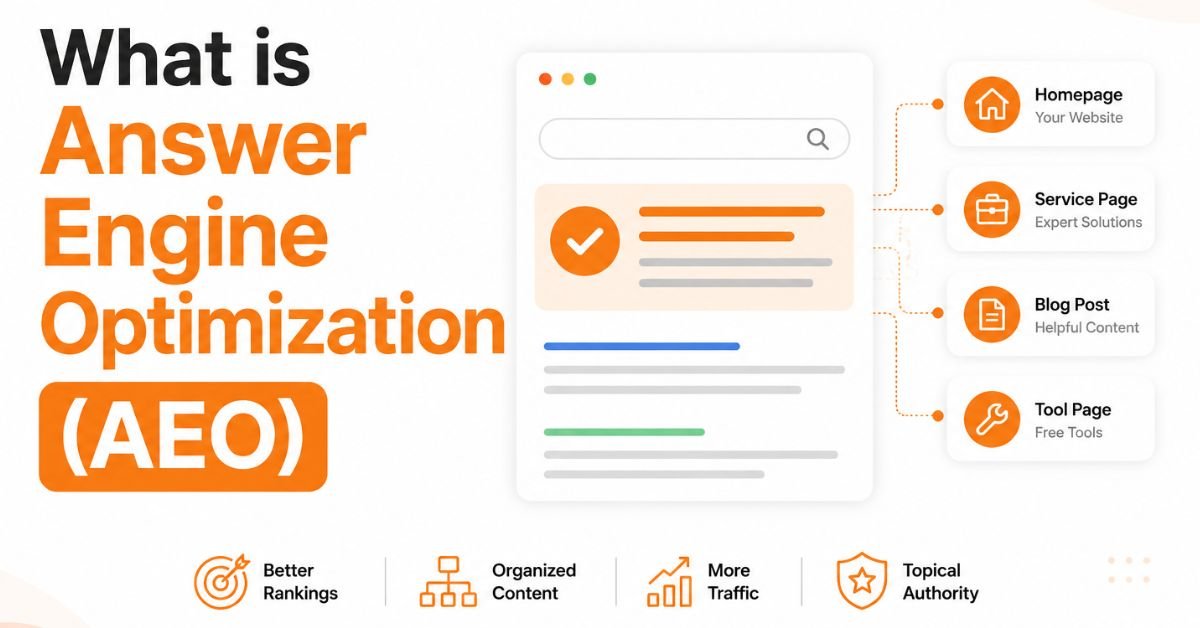
This shift has given rise to a new discipline called Answer Engine Optimization (AEO).
AEO helps your content become the answer that search engines and AI platforms choose to show users.
In this guide, you will learn what AEO is, how it works, why it matters, and how it differs from traditional SEO and GEO.
Key Statistics About AEO and AI Search
The growth of AI-powered search explains why AEO has become one of the most important digital marketing strategies. Here are some notable figures:
| Metric | Data |
|---|---|
| Google AI Overviews monthly users | More than 1.5 billion |
| Countries with AI Overviews availability | More than 100 |
| ChatGPT AI search market share | Around 76.85% among AI search tools |
| Growing trend | More users receive direct AI-generated answers instead of clicking links |
These numbers show a simple reality. AI-powered answers are no longer experimental. They have become a major part of how people discover information online.
Businesses that optimize only for traditional rankings may lose visibility as users increasingly interact with answer engines.
What Is Answer Engine Optimization (AEO)?
Answer Engine Optimization (AEO) is optimizing content in a way that search and answer engines can understand and present it as a direct answer to users.
In simple words, AEO helps your content become the answer instead of just another search result. Traditional SEO focuses on helping pages rank higher. AEO focuses on helping content get selected as the answer.
A Simple AEO Example
Imagine someone asks:
“What is answer engine optimization?” A traditional search engine will display ten blue links on the first page.
But an answer engine will generate a short response, like in the image below:
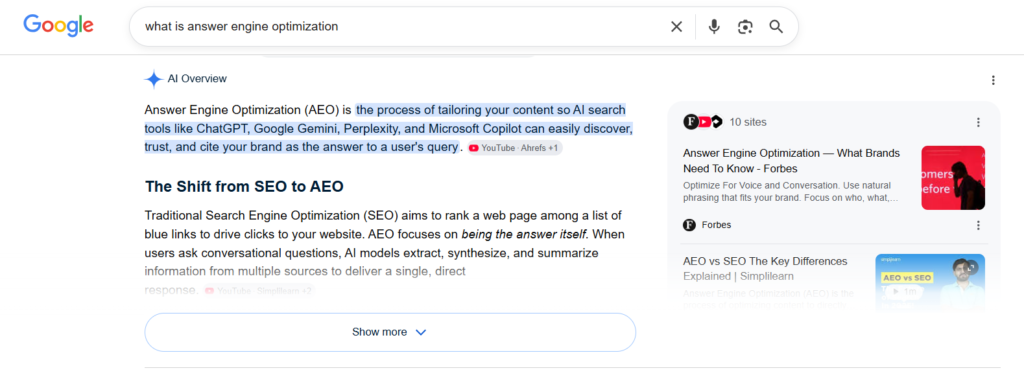
If the answer comes from your content, your website gains visibility even when users never click a link.
That is the core goal of AEO.
Why Is It Called Answer Engine Optimization?
Modern search platforms do much more than retrieve web pages. They analyze content, understand context, identify entities, and generate answers.
Because these systems function as answer providers rather than simple search engines, marketers now refer to them as answer engines.
Examples include:
- ChatGPT
- Google AI Overviews
- Gemini
- Perplexity
- Microsoft Copilot
- Claude
AEO helps content perform better across these answer-focused platforms.
What Are Answer Engines?
Answer engines are systems that provide direct answers to user questions rather than displaying only a list of web pages.
These systems use artificial intelligence, natural language processing, machine learning, and knowledge graphs to understand user intent.
Their goal is simple: Provide the best answer as quickly as possible.
Google AI Overviews
Google AI Overviews generate summaries directly within search results.
Instead of forcing users to visit multiple pages, Google combines information from different sources and presents a concise answer.
This feature now reaches more than 1.5 billion users every month.
ChatGPT
ChatGPT has become one of the most widely used AI platforms. Many users now ask ChatGPT questions they previously searched on Google. As a result, brands increasingly want their content cited and referenced within ChatGPT responses.
Perplexity
Perplexity combines AI-generated answers with source citations. Users receive direct answers while still having access to supporting references.
This model has made Perplexity popular among researchers, professionals, and students.
Gemini
Gemini is Google’s AI assistant. It combines large language models with Google’s vast knowledge systems to generate conversational answers.
Claude
Claude focuses heavily on reasoning and long-form responses. Many businesses now consider Claude visibility an important part of their AI search strategy.
Traditional Search Engines vs Answer Engines
The difference between traditional search and answer-based search is significant.
| Factor | Traditional Search Engines | Answer Engines |
|---|---|---|
| Main Output | List of links | Direct answers |
| User Journey | Search → Click → Read | Search → Answer |
| Goal | Rank pages | Become the answer |
| Content Focus | Keywords | Context and answers |
| Success Metric | Rankings and clicks | Citations and visibility |
| User Experience | Multiple steps | Instant response |
This shift explains why AEO has become so important.
Why AEO Matters That Much
Many marketers still view AEO as a future trend. In reality, it is already affecting how people find information online.
Users Want Instant Answers
Modern users expect speed. They want answers without reading multiple articles or comparing dozens of pages. Answer engines satisfy this demand.
AI Search Continues to Grow
Every major technology company is investing heavily in AI-powered search experiences. The trend is moving toward more direct answers and fewer traditional search journeys.
Visibility Extends Beyond Google Rankings
A page can rank well in Google and still miss opportunities in AI-generated answers. AEO helps brands remain visible across multiple discovery channels.
Better Brand Recognition
When AI systems consistently cite your content, users begin to recognize your brand as a trusted source. This can increase authority, credibility, and future traffic.
Competitive Advantage
Many websites still focus only on traditional SEO. Businesses that invest in AEO today can gain an early advantage while competition remains relatively low.
AEO vs SEO: What’s the Difference?
AEO and SEO share many similarities. However, they serve different goals.
Search Engine Optimization focuses on improving a website’s visibility within search engine results.
SEO aims to:
- Increase rankings
- Drive organic traffic
- Improve click-through rates
- Generate leads and sales
Answer Engine Optimization focuses on helping content become the answer selected by AI systems and search engines.
AEO aims to:
- Increase answer visibility
- Improve AI citations
- Enhance entity recognition
- Strengthen topical authority
Similarities Between SEO and AEO
Both rely on:
- High-quality content
- Strong user experience
- Search intent optimization
- Website authority
- Technical optimization
Key Differences Between SEO and AEO
| Factor | SEO | AEO |
|---|---|---|
| Primary Goal | Rank pages | Become the answer |
| Main Target | Search engines | Answer engines |
| Success Metric | Traffic | Visibility and citations |
| Content Style | Keyword-focused | Answer-focused |
| User Journey | Click to website | Immediate answer |
| Optimization Focus | Rankings | Answer extraction |
The most successful websites combine both approaches. SEO helps users find your content. AEO helps answer engines use your content.
AEO vs GEO: Understanding the Difference
As AI search evolves, another term has become increasingly common: GEO.
GEO stands for Generative Engine Optimization.
It refers to optimizing content for AI systems that generate responses rather than simply retrieve information.
The concept gained attention through academic research focused on how generative AI systems select and reference information.
In practice, GEO and AEO overlap significantly. Both aim to improve visibility within AI-generated answers.
Both focus on:
- Content quality
- Authority
- Structure
- Entity optimization
- Trust signals
AEO vs GEO Comparison
| Factor | AEO | GEO |
|---|---|---|
| Full Form | Answer Engine Optimization | Generative Engine Optimization |
| Primary Focus | Answer engines | Generative AI systems |
| Industry Usage | Common marketing term | Common research term |
| Goal | Become the answer | Become a cited source |
| Optimization Methods | Similar | Similar |
How Answer Engines Work
Most answer engines follow a similar process. They collect information, understand context, evaluate trust signals, and then generate a response.
While each platform uses different technologies, their goals remain the same: provide accurate, helpful, and trustworthy answers.
Step 1: Content Discovery
Before an answer engine can use your content, it must discover it. AI systems gather information from various sources, including:
- Search engine indexes
- Public web pages
- Knowledge bases
- Trusted databases
- Structured content repositories
If search engines cannot crawl or understand your content, answer engines will struggle to use it as well. This is why strong technical SEO remains important.
Step 2: Understanding User Intent
Answer engines do not simply match keywords. They try to understand what the user actually wants.
For example, if someone searches:
“How long does it take to rank on Google?”
The system understands that the user wants a timeframe, not a definition of Google rankings. This ability to understand search intent allows answer engines to deliver more relevant responses.
Step 3: Entity Recognition
Modern AI systems focus heavily on entities.
An entity can be:
- A person
- A company
- A product
- A location
- An event
- A concept
For example:
- OpenAI
- ChatGPT
Answer engines use entities to understand relationships between topics. This helps them generate more accurate answers.
Step 4: Authority Evaluation
Not every webpage receives equal treatment. Answer engines evaluate signals such as:
- Content quality
- Author expertise
- Website reputation
- Source credibility
- External references
- Topic authority
Pages that consistently publish reliable information have a better chance of being cited.
Step 5: Answer Extraction
The system identifies content that directly answers the query. Clear and concise answers often perform best.
Step 6: Response Generation
Finally, the answer engine combines information from one or more sources. The generated response may include:
- Summaries
- Citations
- Follow-up suggestions
- Related questions
- Contextual information
This entire process happens within seconds.
Core Ranking Factors for AEO
Many traditional SEO factors still matter. However, answer engines evaluate content differently than traditional search rankings.
Here are the most important AEO ranking factors.
1. Content Accuracy
Accuracy sits at the center of AEO. AI systems aim to provide trustworthy information. Incorrect, outdated, or misleading content reduces the likelihood of citations.
Best practices:
- Verify facts
- Cite trustworthy sources
- Update statistics regularly
- Remove outdated information
2. Topical Authority
Publishing one article rarely creates authority. Answer engines favor websites that cover an entire topic comprehensively.
For example, a website about SEO should also cover:
- Technical SEO
- On-page SEO
- Keyword research
- Link building
- Local SEO
- Semantic SEO
- AEO
- GEO
Comprehensive coverage helps establish expertise.
3. Search Intent Alignment
Content must match what users actually want. A detailed guide will not satisfy someone looking for a quick definition.
Likewise, a short definition will not satisfy someone researching a complex topic. Intent alignment remains one of the strongest optimization factors.
4. EEAT Signals
Google’s EEAT framework continues to influence content quality evaluation.
EEAT stands for:
- Experience
- Expertise
- Authoritativeness
- Trustworthiness
Strong EEAT signals increase credibility.
Examples include:
- Expert authors
- Real-world examples
- Accurate information
- Transparent sourcing
- Updated content
5. Content Structure
Answer engines prefer content that is easy to understand.
Use:
- Clear headings
- Short paragraphs
- Lists
- Tables
- FAQs
- Definitions
Well-structured content increases answer extraction opportunities.
6. Entity Optimization
Answer engines increasingly rely on entities instead of keywords. Strong entity coverage helps systems understand:
- Who you are
- What you do
- Which topics you cover
- How concepts relate to each other
7. Semantic Relevance
Semantic SEO content should cover the complete context surrounding a topic. For AEO, depth matters more than keyword repetition.
Instead of repeating “Answer Engine Optimization” dozens of times, discuss related concepts such as:
- AI search
- Search intent
- Structured data
- Knowledge graphs
- Entity SEO
- EEAT
- AI citations
This creates stronger semantic relevance.
8. Freshness
AI systems often prefer current information.
This is especially important for:
- Statistics
- Industry trends
- Technology topics
- Regulations
- Product updates
Regular updates help maintain visibility.
AEO Optimization Framework
The following framework provides a practical process for optimizing content for answer engines.
Step 1: Start With Questions
Most AI searches begin as questions.
Research:
- People Also Ask
- Community discussions
- Industry forums
- Customer questions
- AI-generated suggestions
Build content around real questions.
Step 2: Answer Early
Provide a direct answer immediately. Do not make readers search for it.
Good structure:
- Question
- Direct answer
- Expanded explanation
- Examples
- Supporting information
This format works well for answer extraction.
Step 3: Create Comprehensive Topic Coverage
Cover the topic completely. For example, an AEO guide should include:
- Definitions
- Benefits
- Ranking factors
- Search intent
- Schema
- Entities
- GEO
- AI search
Comprehensive coverage builds authority.
Step 4: Use Clear Content Structure
Organize content using:
- H2 headings
- H3 headings
- Bullet lists
- Numbered steps
- Tables
- FAQs
This improves readability for users and machines.
Step 5: Strengthen EEAT
Demonstrate expertise through:
- Original insights
- Real examples
- Industry experience
- Accurate sourcing
- Updated information
Trust remains a major ranking factor.
Step 6: Build Entity Relationships
Connect related entities throughout your content.
Instead of discussing AEO in isolation, connect it with:
- SEO
- AI search
- ChatGPT
- Google AI Overviews
- Structured data
- Knowledge graphs
These relationships improve contextual understanding.
Step 7: Add Schema Markup (Very Important)
Schema helps machines understand content more clearly. We will discuss this in detail later in this guide.
Step 8: Monitor Visibility
Track:
- AI citations
- Organic traffic
- Brand mentions
- Search rankings
- AI Overview appearances
Optimization should be ongoing.
Schema Markup for AEO
Schema markup is one of the most powerful technical elements in AEO. It helps search engines and AI systems understand content without guessing.
What Is Schema Markup?
Schema markup is structured data added to a webpage. It provides machine-readable information about content.
Think of schema as labels that explain what each piece of content represents.
- Without schema: Search engines interpret content.
- With schema: Search engines understand content.
This reduces ambiguity and improves content classification.
Best Schema Types for AEO
| Schema Type | Primary Purpose | AEO Value |
|---|---|---|
| Article | Content understanding | High |
| FAQ | Question-answer extraction | Very High |
| HowTo | Step-by-step instructions | Very High |
| Organization | Brand understanding | High |
| Person | Author expertise | High |
| Product | Product information | High |
| Breadcrumb | Content hierarchy | Medium |
Schema Best Practices
- Use valid structured data
- Follow Schema.org guidelines
- Keep schema updated
- Match schema with visible content
- Test implementation regularly
- Avoid misleading markup
Schema alone will not guarantee AI citations.
However, when combined with strong content, semantic SEO, entity optimization, and EEAT, it significantly improves machine understanding.
The Future of AEO
AEO continues to evolve rapidly. Several trends will shape the future of search.
More AI-Generated Answers
Answer engines will continue expanding. Users increasingly expect immediate responses.
Conversational Search Growth
Search behavior is becoming more natural and conversational. People now ask complete questions instead of typing short keyword phrases.
Multi-Step Search Journeys
Users increasingly engage in follow-up conversations. Content must support entire journeys rather than single queries.
Greater Importance of Entities
Entity understanding will become even more important. Brands that establish strong entity relationships will gain advantages.
Stronger Focus on Trust
As AI-generated content grows, trustworthy information becomes more valuable. Reliable sources will likely receive greater visibility.
Final Thoughts
Answer Engine Optimization is not a replacement for SEO.
It is an evolution of search optimization.
Search engines increasingly provide answers instead of links. At the same time, AI assistants continue changing how people discover information.
Businesses that adapt early can build visibility across traditional search engines and emerging AI platforms.
The core principles remain surprisingly simple:
- Create accurate content.
- Demonstrate expertise.
- Build topical authority.
- Optimize entities.
- Use structured data.
- Focus on user intent.
- Earn trust.
When these elements work together, your content becomes easier for answer engines to understand, reference, and recommend.
Frequently Asked Questions
What is AEO in SEO?
AEO, or Answer Engine Optimization, is the process of optimizing content so search engines and AI systems can use it as a direct answer to user questions.
What is the difference between SEO and AEO?
SEO focuses on ranking web pages in search results. AEO focuses on helping content become the answer presented by AI systems and answer engines.
Is AEO replacing SEO?
No. AEO complements SEO. Strong SEO foundations often improve AEO performance.
Does schema markup help AEO?
Yes. Schema markup helps search engines and AI systems understand content more accurately, which can improve answer extraction and content interpretation.
Which schema types are best for AEO?
Article Schema, FAQ Schema, HowTo Schema, Organization Schema, and Person Schema are among the most useful schema types for AEO.
