
Meta Tags in SEO: What they are & How to use them?
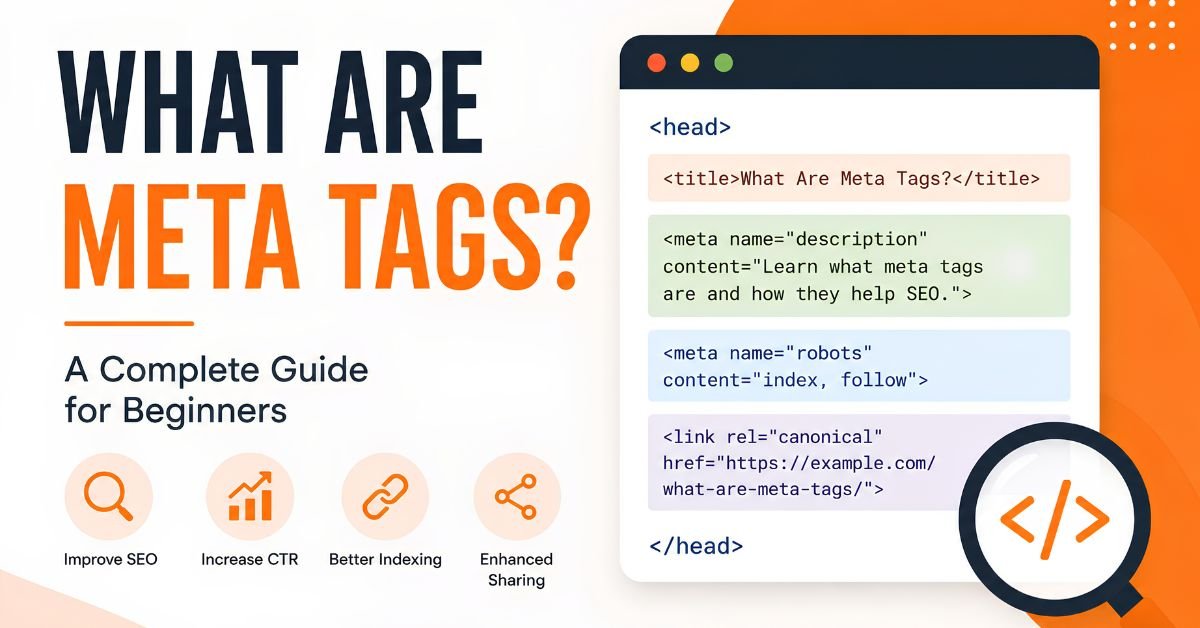
Meta tags in SEO are small pieces of HTML code that help search engines understand a webpage. They sit inside the source code of a page and provide important information about the content.
Most website visitors never see meta tags directly. However, search engines like Google use them to understand, index, and display pages in search results.
Meta tags also help social media platforms create link previews. In addition, AI search systems use metadata to better understand page context.
Today, meta tags matter for:
- SEO
- AEO (Answer Engine Optimization)
- GEO (Generative Engine Optimization)
- Click-through rates
- Search visibility
- User experience
- Social sharing
Many beginners think every meta tag improves rankings directly. That is not true. Some meta tags help search engines crawl and understand content. Others improve visibility and user engagement.
Let’s start from the basics.
What Are Meta Tags in SEO?
SEO Meta tags are snippets of HTML code that provide information about a webpage. They usually sit inside the <head> section of a webpage.
Here is a simple example:
<meta name="description" content="Learn what meta tags are and how they help SEO. Explore different types of SEO meta tags">This tag tells search engines what the page is about. Meta tags work behind the scenes. Visitors normally do not see them on the page itself.
SEO meta tags help search engine crawlers understand:
- The topic of the page
- The purpose of the page
- Whether the page should appear in search results
- How the page should look in search snippets
Search engines read these tags while crawling websites. Without proper metadata, search engines may struggle to understand your content correctly.
Why Meta Tags Matter for SEO?
Meta tags still play an important role in modern search engine optimization. They help search engines, AI systems, and users understand your content faster.
How Do Search Engines Use Meta Tags?
Search engines use meta tags during crawling and indexing. These tags help search engines:
- Understand page topics
- Identify page relevance
- Create search result snippets
- Decide whether to index a page
- Understand canonical versions of URLs
For example, the title tag often appears as the blue clickable headline in Google search results. Similarly, the meta description may appear below the title (this can be different).
AI Search Engines & Meta Tags
AI search engines are becoming more common. Platforms like ChatGPT, Google AI Overviews, Perplexity, Gemini, and Bing Copilot rely heavily on structured information.
Meta tags help these systems understand:
- Context
- Topical focus
- Page summaries
- Content relevance
- Entity relationships
Clear metadata improves the chances of your content appearing in AI-generated answers. This is why modern SEO now includes GEO, which stands for Generative Engine Optimization.
How Meta Tags Influence User Behavior?
Meta tags also affect how users interact with your content. Especially, good title tags and descriptions can improve:
- Click-through rates
- Trust
- Relevance perception
- User engagement
If your title looks clear and useful, more people may click your page. On the other hand, poor metadata can reduce clicks even if your rankings are good.
Meta Tags vs Ranking Factors
Not every meta tag directly improves rankings. For example, title tags strongly influence SEO. Meta description tags have nothing to do with rankings.
While robots.txt affects indexing, canonical tags help search engines better understand duplicate content.
So, meta tags often support SEO indirectly by improving crawlability, understanding, and user engagement.
The Most Important Meta Tags for SEO
There are different types of SEO meta tags. Some meta tags matter much more than others. Here are the most important ones.
Title Tag
The title tag defines the title of a webpage. It is one of the most important SEO elements. Search engines usually display the title tag as the clickable headline in search results.
Example:
<title>What Are Meta Tags? Complete Beginner's Guide</title>A strong title tag helps both search engines and users. They also influence click-through rates.
Here are some recommended practices to write good title tags:
- Place the primary keyword naturally
- Keep the title clear and relevant
- Match search intent
- Make the title compelling
- Avoid keyword stuffing
- Keep the length around 50 to 60 characters
Pro Tip: Use meta title checker utility to craft better SEO title tags.
Avoid these mistakes:
- Duplicate titles
- Misleading titles
- Very short titles
- Overly long titles
- Keyword stuffing
Meta Description
A meta description is the summary of a webpage. Google may show this description in search results. However, Google sometimes rewrites descriptions based on search queries.
Example:
<meta name="description" content="Learn what meta tags are, why they matter for SEO, and how to optimize them correctly.">Meta descriptions do not directly improve rankings. Still, they can improve click-through rates. A good description helps users understand what they will find on the page.
Best Practices for Meta Descriptions:
- Write naturally
- Include the main keyword naturally
- Match search intent
- Explain benefits clearly
- Add a call to action
- Keep the description around 150 to 160 characters (use meta description checker for assistance)
Meta Robots Tag
The robots meta tag controls how search engines interact with a page. This tells search engines:
- Follow the links on the page
- Index the page
Example:
<meta name="robots" content="index, follow">Common Robots Directives
- index: Allows search engines to index the page.
- noindex: Prevents the page from appearing in search results.
- follow: Allows search engines to follow links.
- nofollow: Tells search engines not to follow links.
- noarchive: Prevents cached versions from appearing.
Important:
Many websites accidentally block important pages using noindex. This mistake can remove pages from Google completely. Always check robots settings carefully.
Canonical Tag
The canonical tag tells search engines which version of a page is the main version. Many websites create duplicate URLs.
For example:
- Filtered ecommerce pages
- Tracking URLs
- HTTP and HTTPS versions
- URLs with parameters
Canonical tags help consolidate ranking signals. They also reduce duplicate content confusion.
Example of canocial tag:
<link rel="canonical" href="https://example.com/meta-tags/">Viewport Meta Tag
The viewport meta tag helps websites display correctly on mobile devices. Mobile responsiveness is very important for SEO. Google uses mobile-first indexing.
- A proper viewport tag improves:
- Readability
- User experience
- Mobile usability
- Core Web Vitals
Viewport meta tag example:
<meta name="viewport" content="width=device-width, initial-scale=1.0">Charset Meta Tag
The charset meta tag defines character encoding. UTF-8 helps browsers display text correctly. Without proper encoding, websites may show broken characters.
Example:
<meta charset="UTF-8">Open Graph Meta Tags
Open Graph tags control how content appears on social media. Facebook originally introduced them. Today, many platforms use Open Graph metadata.
Example:
<meta property="og:title" content="What Are Meta Tags?">Some Important Open Graph Tags
- og:title – Defines the social media title.
- og:description – Defines the social media description.
- og:image – Defines the preview image.
Meta Tags That No Longer Matter Much for SEO
Some meta tags were important years ago. Today, search engines mostly ignore them.
Meta Keywords Tag
The meta keywords tag once allowed website owners to list keywords. Google no longer uses this tag for rankings. People abused it heavily through keyword stuffing. As a result, modern search engines ignore it.
Revisit-After Meta Tag
This tag tried to tell search engines when to revisit a page. Search engines no longer rely on it. Modern crawlers decide crawl frequency automatically.
Geo Meta Tags
Geo meta tags once helped define geographic targeting. Today, search engines rely more on:
- Structured data
- Google Business Profile
- IP and server signals
- Local SEO signals
How Meta Tags Appear in Google Search Results?
Meta tags often shape how pages appear in search results.
A typical search snippet includes:
- Title
- URL
- Description
Google may rewrite titles or descriptions when Metadata is:
- Unclear
- Misleading
- Does not match search intent
- Too long
This is why writing clear and accurate metadata matters.
Best Practices for Writing SEO Meta Tags
Good meta tags improve both SEO and user experience. Here are the best practices you should follow.
Match Search Intent
Always understand what users want. There are different types of search intent:
- Informational
- Transactional
- Navigational
Your metadata should align with user intent.
Avoid robotic writing. Use clear and natural language. Focus on helping users understand the page.
Make Every Page Unique
Every important page should have unique metadata. Duplicate titles and descriptions can confuse search engines.
Use Keywords Naturally
Keywords still have importance in SEO. Place keywords naturally. Do not stuff keywords repeatedly. Search engines understand topics and context much better today.
Optimize for Click-Through Rate
Good metadata attracts clicks. You can improve CTR by using:
- Numbers
- Benefits
- Clear wording
- Emotional triggers
- Curiosity
Keep Meta Tags Updated
Update metadata regularly. This is especially important for:
- Old blog posts
- Seasonal content
- Updated guides
- Product pages
Align Metadata With Page Content
Your metadata should accurately describe the page. Misleading metadata increases bounce rates and hurts trust.
Pro Tip: Use the Meta Tag Analyzer to optimize your meta titles and descriptions for SEO with better keyword placement.
How to Add Meta Tags in WordPress?
WordPress makes metadata optimization easier. Most website owners use SEO plugins.
Using Rank Math
Rank Math is a popular SEO plugin. You can use it to:
- Edit title tags
- Add meta descriptions
- Configure robots settings
- Add social metadata
- Manage schema markup
The plugin provides easy fields inside the WordPress editor.
Using Yoast SEO
Yoast SEO also helps manage metadata. You can:
- Create SEO titles
- Add descriptions
- Control indexing
- Preview snippets
Adding Meta Tags Manually
Advanced users can add tags manually inside HTML.
Example:
<head>
<title>What Are Meta Tags?</title>
<meta name="description" content="Learn everything about SEO meta tags.">
</head>
Beginners should use plugins unless they understand HTML well.
Final Thoughts
Meta tags remain one of the foundations of SEO. They help search engines understand webpages. They also improve visibility, user engagement, and social sharing.
Modern SEO is no longer only about rankings. Today, websites also need optimization for:
- AI search
- Answer engines
- Generative search systems
- User experience
Good metadata improves all of these areas. The best approach is simple.
Write clear, honest, and useful metadata that accurately describes your content. Focus on users first while helping search engines understand your pages better.
Meta Tags FAQs
Do Meta Tags Help Rankings?
Some meta tags directly support SEO, while others improve visibility indirectly. For example, title tags help search engines understand page topics, while meta descriptions can improve click-through rates.
Which Meta Tag Is Most Important?
The title tag is usually the most important SEO meta element. It helps search engines understand the page and often appears as the clickable headline in Google search results.
Does Google Still Use Meta Keywords?
No. Google no longer uses the meta keywords tag for rankings. Search engines stopped relying on it because many websites abused it through keyword stuffing.
What Is the Ideal Meta Title Length?
Keeping title tags around 50 to 60 characters usually works best. This helps prevent truncation while keeping enough space to explain the page clearly.
What Is the Ideal Meta Description Length?
Most meta descriptions work best around 150 to 160 characters. The description should clearly summarize the page and encourage users to click.
Can Google Rewrite Meta Tags?
Yes. Google sometimes rewrites titles and meta descriptions. This usually happens when metadata is too long, unclear, misleading, or does not match the search query.
Are Meta Tags Important for AEO and GEO?
Yes. AI search systems use metadata to better understand page topics, context, and relevance. Clear metadata can improve visibility in AI-generated answers.
How Often Should I Update Meta Tags?
Review meta tags regularly, especially after updating content or noticing lower click-through rates. Refreshing metadata can improve visibility without rewriting the entire page.
What Happens If a Page Has No Meta Description?
Google may automatically generate a description from the page content. However, writing your own description gives you more control over how your page appears in search results.
