
How Many Types of Keywords in SEO?
There are different types of keywords in SEO. Learn intent based, long tail, and commercial keywords with simple examples and strategy tips.
In our previous blog post, we defined keywords and their importance. Keywords are the words and phrases people type into search engines when they want to find something. These words help search engines understand what a page is about. They also help websites connect with the right audience.
However, not all keywords are the same. People search with different goals. Some want to learn. Some want to buy. Others want to visit a specific website. That is why SEO experts divide keywords into different types.
What Are the Different Types of Keywords in SEO?
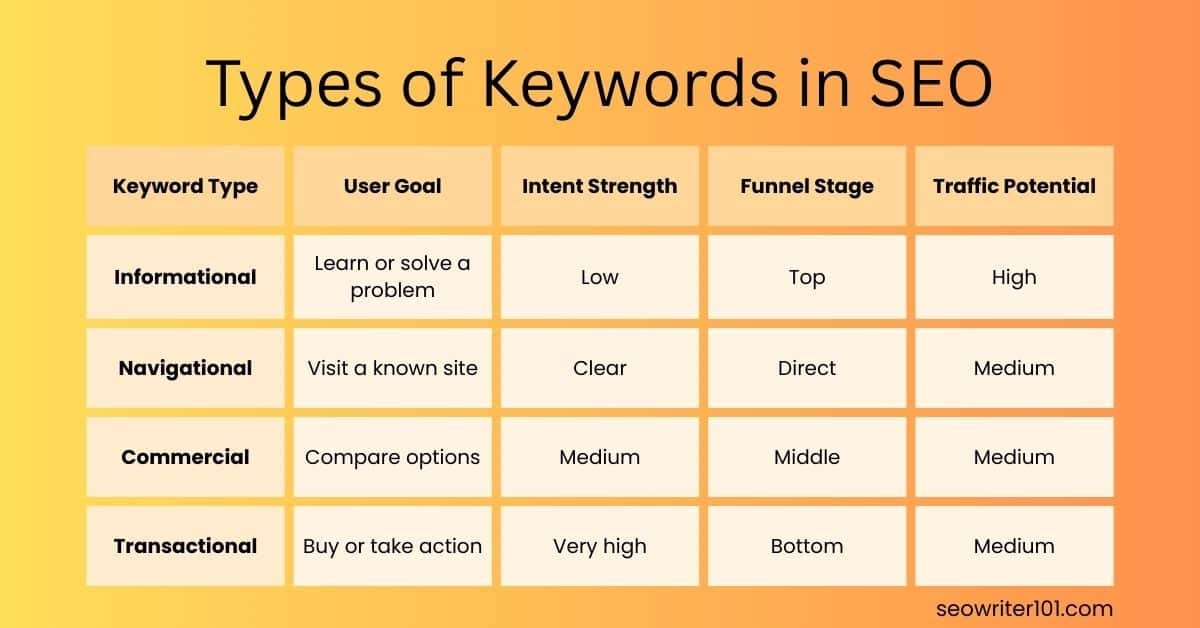
Based on intent, keywords are divided into four main types.
Search intent means the reason behind a search. When someone types a keyword, they always have a goal in mind. And that goal is their intent.
Here are four main types of keywords based on intent.
1. Informational Keywords
Informational keywords are used when people want to learn something. They are not ready to buy yet. They simply want answers.
For example, if someone searches for how to fix a slow website, you are looking for guidance. They want steps or tips. They are not trying to purchase anything at that moment.
Informational keywords usually:
- Start with words like how, what, why, or guide
- Aim to solve a problem
- Target users at the learning stage
These keywords often sit at the top of the marketing funnel because users are still exploring.
2. Navigational Keywords
Navigational keywords are used when someone wants to visit a specific website or page. For example, if you search for “YouTube login,” you already know where you want to go.
You just use Google to reach that page faster.
These keywords usually include brand names or product names. The intent is clear.
The user wants to navigate, not explore.
3. Commercial Keywords
Commercial keywords show buying interest. However, the user still compares options before making a final decision.
For example, if you search for “best SEO tools for small business,” you probably want to compare:
- Features
- Prices
- Reviews
You are close to buying, but you want more information first.
Commercial keywords often include words such as:
- Best
- Top
- Review
- Comparison
- Affordable
These keywords sit in the middle of the funnel and support decision making.
4. Transactional Keywords
Transactional keywords show strong action intent. The user is ready to take the next step.
For example, if you search for “buy running shoes online,” you clearly want to make a purchase. You are not researching anymore. You are ready to act.
These keywords often include words like:
- Buy
- Order
- Discount
- Sign up
They usually bring higher conversion rates because the intent is strong.
8 Other Types of Keywords in SEO
You are also categorized into other types for different purposes. These categories help you plan better content and understand competition.
1. Keyword Types by Word Length
Some keywords are short. Others are long and detailed.
Short-tail keywords usually have one or two words. For example, if you search for “shoes,” that is a short-tail keyword. It is very broad.
Mid-tail keywords are slightly more specific. For example, if you search for “running shoes,” you narrow the topic a little.
Long-tail keywords are longer and very specific. For example, if you search for “best running shoes for flat feet,” you clearly explain what you need.
You can understand it in a simple way:
- Short-tail keywords bring high traffic but high competition.
- Mid-tail keywords balance traffic and competition.
- Long-tail keywords bring targeted traffic with lower competition.
Research shows that around 92 percent of search queries are long-tail keywords. This means users often search in detailed ways instead of broad terms.
2. Keyword Types by Difficulty
Keyword difficulty shows how hard it is to rank for a keyword.
- If a keyword has low difficulty, fewer strong websites compete for it. That makes it easier to rank.
- If a keyword has high difficulty, many powerful websites already rank for it. That makes ranking harder.
Keyword research tools calculate this score based on different metrics.
3. Keyword Types by Volume
Search volume tells you how many times people search for a keyword each month.
- If many people search for a term, it has high volume. If only a few search for it, it has low volume.
- Most search queries have low volume because users search in many unique ways.
This shows why targeting long and specific phrases works well.
4. Keyword Types by Match Type
Match types are mostly used in paid ads.
- Broad match allows your content or ad to appear for related searches.
- Phrase match shows results when the phrase appears in the same order.
- Exact match only triggers results when the exact words are used.
This system helps control visibility in advertising campaigns.
5. Keyword Types by Seasonality
Some keywords stay popular all year. These are evergreen keywords.
For example, if you search for “how to tie shoes,” people search for that all year.
Other keywords are seasonal.
For example, if you search for “Christmas gift ideas,” interest increases during the holiday season.
6. Keyword Types by Focus
- Every page should have a primary keyword. This is the main topic.
- Then you add secondary keywords to support the main topic.
You can also use related terms that help search engines understand context.
When writing SEO content, follow this simple order:
- Choose one primary keyword.
- Add two to four secondary keywords.
- Include related terms naturally in the content.
This structure improves clarity and topical depth.
7. Keyword Types by Brand Relation
Some searches include brand names. These are branded keywords.
For example, if you search for “Nike running shoes,” you clearly want that brand.
Other searches do not mention brands. These are non-branded keywords, such as “best running shoes for beginners.”
Non-branded keywords often bring new users to your website.
8. Question Keywords
Question keywords appear in question form.
For example, if you search for “what is SEO,” you want a direct answer.
These keywords often rank in featured snippets. Also, voice searches usually follow question patterns.
In fact, studies show that about 20 percent of mobile searches happen through voice. That increases the value of question-based keywords.
Examples of SEO Keywords
So that you now know different types of keywords in SEO, let us look at real-world examples across different industries. This will help you see how one business can target multiple keyword types.
Example 1: Coffee Machine Business
If you sell coffee machines, you can target keywords like this:
Informational keywords
- how does an espresso machine work
- how to clean a coffee machine
- what is the difference between espresso and drip coffee
These keywords attract users who want to learn.
Commercial keywords
- best espresso machine for home use
- top coffee machines under 300
- espresso machine reviews
These users compare options before buying.
Transactional keywords
- buy espresso machine online
- order coffee machine with free delivery
- discount on espresso machines
These users are ready to purchase.
Example 2: SEO Agency
If you run an SEO content agency like SEOWriter101, your keyword targeting may look like this:
Informational keywords
- what is SEO
- how does SEO work
- why is SEO important for business
Commercial keywords
- best SEO agency for small business
- SEO services comparison
- affordable SEO packages
Transactional keywords
- hire SEO expert
- book SEO consultation
- get SEO services quote
This layered targeting helps you cover the full funnel.
Example 3: Fitness Website
If you manage a fitness blog or product store:
Informational keywords
- how to lose belly fat
- best exercises for beginners
- healthy diet plan for weight loss
Commercial keywords
- best protein powder for muscle gain
- treadmill vs elliptical comparison
Transactional keywords
- buy protein powder online
- order home treadmill
Comparison of Different Types of Keywords in SEO
| Keyword Type | User Goal | Intent Strength | Funnel Stage | Traffic Potential | Ranking Difficulty | Conversion Potential |
| Informational | Learn or solve a problem | Low | Top | High | Low to Medium | Low |
| Navigational | Visit a known site | Clear | Direct | Medium | Low | Low |
| Commercial | Compare options | Medium | Middle | Medium | Medium | Medium |
| Transactional | Buy or take action | Very High | Bottom | Medium | High | High |
| Short-tail | Explore broad topic | Low | All | Very High | Very High | Low |
| Long-tail | Find specific solution | Medium to High | All | Lower individually | Lower | Medium to High |
Wrapping Up
There are four main types of keywords based on intent. These include informational, navigational, commercial, and transactional keywords. They help you understand why people search and what they want to do next.
In this blog post, we also explained other keyword types. Each type helps you plan your content in a smarter way.
When you combine these keyword types in one clear strategy, you create strong SEO. You attract the right audience and increase conversions step by step.
Frequently Asked Questions
How many types of keywords are there in SEO?
There are four main types based on intent. However, you can classify keywords in many other ways, such as by length, volume, and difficulty.
Which keyword type is best for sales?
Transactional keywords usually bring the highest conversions because users are ready to act.
Are long-tail keywords better than short-tail keywords?
Long-tail keywords are often easier to rank for and attract more targeted traffic. However, both types are important in a balanced strategy.
Can one page target multiple keyword types?
Yes. A well-written page can rank for many related keywords when it covers the topic clearly and deeply.
